If you are a business owner or technical lead in 2026, you have likely run into the limitations of traditional Content Management Systems (CMS) like WordPress, Joomla, or Drupal. While these platforms democratized website building a decade ago, today's digital landscape demands far more.
Between plugin bloat, sluggish load times, and endless security patches, relying on a pre-packaged template can actively harm your digital growth.
Enter Custom Web Development. Building a full-stack website from the ground up—using modern frameworks—is no longer just for tech giants. It is a strategic business decision. Let's dive into the five game-changing advantages of choosing a full-stack web application over a traditional CMS.
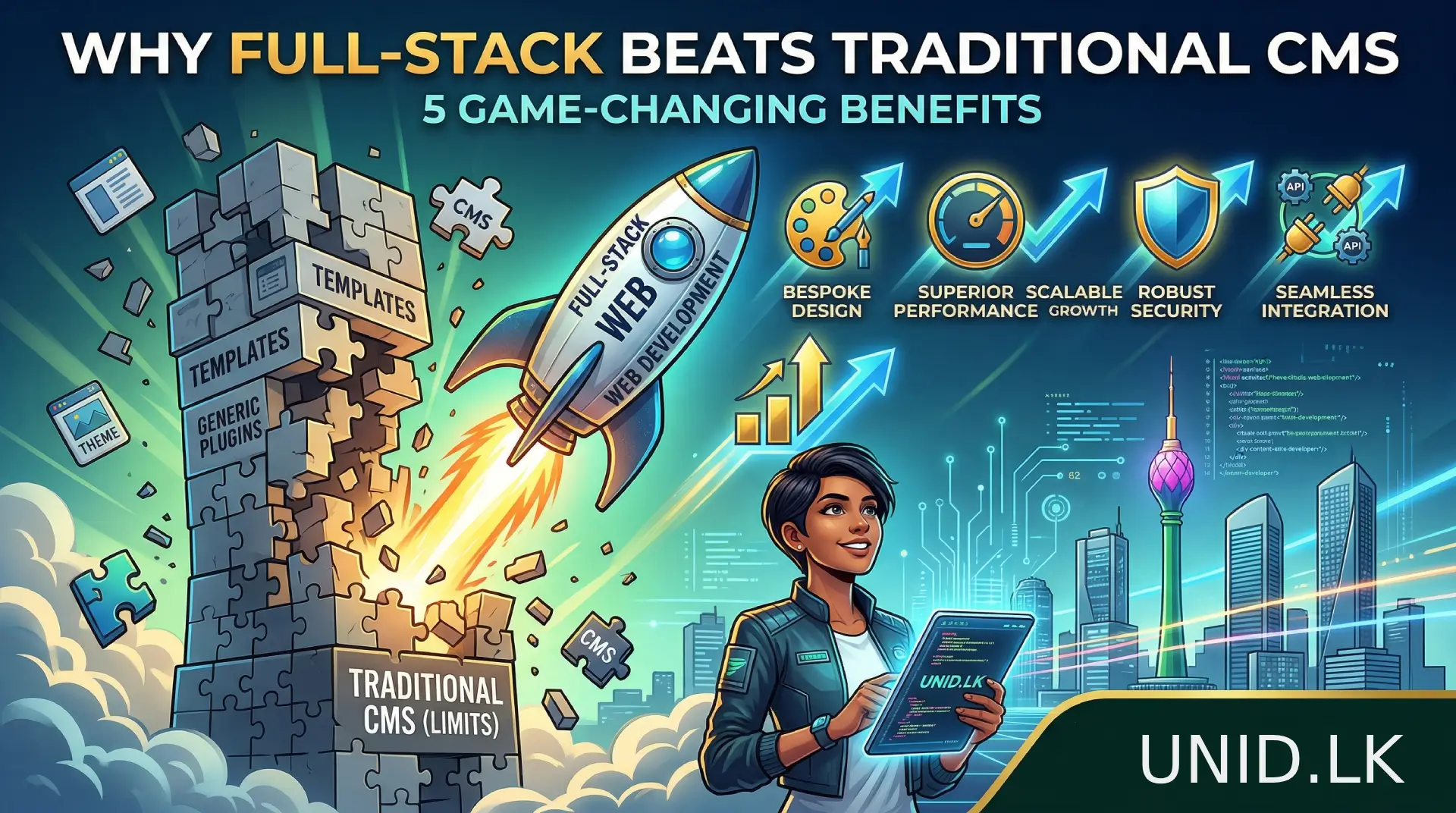
1. Blazing Fast Performance and Flawless User Experience (UX)
When a user clicks your link, you have less than three seconds to capture their attention. Search engines like Google now heavily penalize slow websites by downgrading them in search results based on Core Web Vitals.
The CMS Problem: Traditional CMS platforms are notoriously heavy. They load massive libraries of unused CSS and JavaScript just to display a simple page. Every plugin you add slows down your server response time.
The Full-Stack Advantage: With custom web development, developers write lean, purpose-built code. By utilizing modern frameworks like Next.js, you can leverage Server-Side Rendering (SSR) and Static Site Generation (SSG). This means your website's pages are pre-built and delivered instantly to the browser. The result? Near-instantaneous page loads, a frictionless User Experience (UX), and a massive boost to your SEO rankings.
2. Unmatched Scalability and Seamless Integrations
Your website should grow alongside your business, not hold it back.
The CMS Problem: CMS platforms are like living in a rented, pre-furnished apartment. If you want to knock down a wall to build a custom customer portal or integrate a complex third-party API, you quickly realize the architecture wasn't built for it. You end up relying on "duct-tape" solutions by stacking incompatible plugins together.
The Full-Stack Advantage: A full-stack website offers infinite scalability. You dictate the architecture. Need a bespoke booking system, a real-time inventory dashboard, or AI-driven personalization? It can be seamlessly coded into the core.
Furthermore, you don't have to give up easy content editing. By pairing your custom front-end with a Headless CMS (like Sanity, Contentful, or Strapi), your marketing team gets a beautiful dashboard to publish blogs, while your developers maintain total control over how that content is displayed and delivered.
3. Bulletproof Security Architecture
Cybersecurity threats are more sophisticated than ever, and popular CMS platforms are the internet's biggest targets.
The CMS Problem: Because WordPress alone powers over 40% of the web, hackers write automated scripts that constantly scan for vulnerable plugins or outdated core files. Once a single vulnerability is found in a popular plugin, millions of sites are instantly at risk. Furthermore, traditional CMS platforms have predictable file structures and public-facing admin login pages (e.g., /wp-admin), practically inviting brute-force attacks.
The Full-Stack Advantage: Custom web development inherently drastically reduces your attack surface.
- Your codebase is unique, meaning automated bots cannot easily exploit known architectural flaws.
- APIs and databases are decoupled from the front-end interface.
- There is no standardized "admin portal" exposed to the public web.
4. Total SEO Control and Clean Code
Search Engine Optimization is about much more than just stuffing keywords into a blog post; technical SEO is the foundation of high organic traffic.
The CMS Problem: Many page builders and visual editors generate "div soup"—messy, deeply nested HTML code that is a nightmare for Google’s crawlers to read and index. Additionally, you are often at the mercy of SEO plugins that offer limited control over complex schema markups or dynamic metadata.
The Full-Stack Advantage: A custom-built site provides 100% control over the DOM (Document Object Model). Developers can ensure the HTML structure is semantic, accessible, and lightweight. You can programmatically generate precise metadata, dynamically render XML sitemaps, and optimize the exact Time to Interactive (TTI) metrics that search engines reward.
5. Long-Term Cost Efficiency and True Ownership
A common misconception is that a traditional CMS is the "cheaper" option. While the initial setup might cost less, the long-term total cost of ownership (TCO) tells a different story.
The CMS Problem: The "hidden costs" of a CMS accumulate quickly. You end up paying recurring annual fees for premium plugins, specialized managed hosting, and constant developer hours just to run updates, fix conflicting plugins, and patch security holes. When a core update breaks your site, you lose revenue.
The Full-Stack Advantage: Custom full-stack development requires a higher upfront investment, but the ongoing maintenance costs plummet. You aren't paying monthly "rent" to dozens of third-party plugin developers. Because the code is tailored specifically to your needs without unnecessary bloat, it rarely "breaks" randomly. You own a proprietary digital asset that delivers a vastly superior Return on Investment (ROI) over its lifespan.
At a Glance: Full-Stack vs. Traditional CMS
| Feature | Traditional CMS | Custom Full-Stack Website |
|---|---|---|
| Speed & Performance | Average (Heavily relies on plugins) | Elite (Optimized, lightweight code) |
| Security Risk | High (Targeted by botnets) | Low (Unique architecture) |
| Scalability | Limited (Bound by plugins) | Unlimited (Can build anything) |
| Technical SEO | Good (Requires SEO plugins) | Superior (Semantic code, native control) |
| Maintenance | Constant (Weekly patches needed) | Minimal (Stable, predictable) |
The Bottom Line
If you are a hobbyist launching a personal blog, a traditional CMS might be all you need. However, if you are a scaling enterprise, an e-commerce brand, or a tech-forward startup, your website is your most important digital asset.
Relying on generic templates and bloated plugins limits your potential. By investing in custom web development, you secure a blazing-fast, secure, and highly scalable platform designed to dominate your market.